I gripped the chalk, a grain about half the size of the nail on my pinkie finger, and about as thick – tightly between my thumb and forefinger. My hand trembled slightly as I raised my hand up to the smooth wooden chalkboard. It leaned against the wall behind me and rested perilously upon a wooden bench opposing another one of the same, upon which sat my first ever class of students. Eight pairs of eyes stared up at me eagerly: some familiar, some not, and all clearly waiting upon my next words of instruction. Each of them had already flipped to a fresh page in their books, pen or pencil at the ready. I turned to face the board, and began to write, a shadow of chalk powder trailing my fingers as I sketched out the letter “E”. And so it began.
Showing posts with label self reflection. Show all posts
Showing posts with label self reflection. Show all posts
The class, as of now comprises of 8 kids. Some of them are from the orphanage, and others are from the community around the orphanage. I hope I can find a couple more children over the weekend in bring the number to about 15. We meet at the orphanage from 10am to 12pm, Tuesdays and Thursdays. They vary in age from 10-16 and all have some background in English, but nothing more than “good morning” or “fine, thanks”.
I am not a qualified teacher. I don’t have experience teaching groups. I’ve never even tutored English. Before my first lesson on Thursday, I hadn’t created a lesson plan, anticipated the interest level of the students, formed a method to gauge the previous understanding of English my students held, or realized how hard it would be to keep everyone engaged when I had such varied levels of comprehension to work with. So you can see why I was nervous right before the lesson.
Although we started kind of shakily, just like my confidence, the lesson began to settle as I got into a steady rhythm. Before long, it was flowing naturally. The most rewarding thing as a teacher is when you spend 10 minutes explaining something and then a child is able to apply what you said to answer a question about it. Not only does it keep the kids engaged, but it is such necessary feedback for me to receive when I’m up there, just so I know if I need to do a better job of explaining or if I can move on.
On the other hand, it can be equally frustrating when you feel like you’ve spent your time teaching something and not a single hand goes up when you ask a question. Or when you have to stop mid sentence because it is clear that no one is listening. Nevertheless, after my first lesson was complete, I was feeling pretty good about myself and what we had gotten through – then one of the students reminded me that they need homework.
After assigning the homework, I could already see myself thinking ahead to the next lesson, anticipating how it was going to play out. I was kinda excited! Starting these lessons was a great idea – it provides some structure to my day, and gives me a set schedule. And to be honest, its more motivating than grant work because with this you can see the results much more immediately.
I have a lot of respect for teachers. I always have, even before Thursday, but a little more empathetically now. It is not easy to stand in front of a class full of people and keep them entertained while juggling parenting, teaching, staying patient, being a role model, and always trying to spark some passion all at the same time. However, teachers have to deal with more than just these things. Back home, I have shied away from thinking about a career in teaching just because of all the inner politics that exist within the education system’s hierarchy. It is disheartening how the school can be a truly bureaucratic institution, and that is not something I think I can deal with. What I’ve seen as a student is probably only the tip of the iceberg. I’m glad that I can stay away from that in my small English lessons at the orphanage, but there are those who don’t, and brave the sometimes hostile environment to teach kids who might never realize or appreciate the impact that their teachers often have in shaping who they are.
So I guess the title of this post ended up being one of those classic “phrases with intended double meaning” (is that really classic? I kinda just made that part up). I suppose it’s only fitting that I probably learned more than my students during my first lesson, because part of being a teacher is having a constant willingness to learn as well as teach. Teachers deserve a lot more respect than they ever actually get, and in my eyes it’s as prestigious of a profession as the doctors and lawyers of this world can lay claim to. The role of a teacher is so important that becoming one should be just as selective of a process as choosing doctors or lawyers. My thoughts on how little training teachers require in comparison to those two other professions is a rant made for a different post. Here, let me just take the opportunity to thank the teachers that have been such an important part of my life.
One love to my teachers, if any of you are reading this. And if you just so happened to teach me English in primary school, would you mind if I took a look at your lesson plans quickly? Peace.
As the baby child in a family of six, I’ve never really understood what it meant to have younger or baby siblings. It’s something I’ll never experience fully, but living in a host family with 3 younger kids is the closest I think I’ll ever get to it. Forgive me if this is a bit of a boring post, but the dynamics of having younger siblings is so unique and interesting to me that I had to spend some time talking about this.
I get to observe how the baby always gets his way (now I understand why I was resented by my sisters), all the sibling infighting, and daily ups and downs first hand. Sometimes the patience of Yannick and Melissa when dealing with Aristotle amazes me – they will endure random abuse, hair pulling, and spitting as if it is nothing. Aristotle cries about everything and I often get so annoyed by him, but the next moment he will do something so adorable that all is forgotten.
So much is always expected out of Yannick and Melissa as well, and they seem to handle being pulled away from what they’re doing to go help their mom so well. Melissa a bit less, but to be fair she is younger than Yannick at 12 by about 3 years, at 8. Their relationship is so entertaining to observe. Yannick is a little too cool for Melissa, and is always jokingly asserting himself as the clear superior, which often results in hilarity when Melissa outdoes him. It is so interesting to note how much he changes when 17 year old Alberique is at home, to be in his favour!
 |
| Being young - caption contest in the comments... winner gets a small souvenir! |
Melissa and Yannick chase each other around the house, always playfully – I don’t think I’ve ever actually seen them fight. Aristotle no doubt joins in, never wanting to miss out on the fun. Right now Yannick is using the classic “run circles around a central object” method to avoid Melissa’s chase. I was a student of that style myself about 8 years ago, on the other side of the world... some things are universal. It makes me feel so nostalgic!
Melissa and Yannick will have their moments where they team up to tease Aristotle as much as they can without making him cry – their method of exacting revenge on him always getting his way. I’m not gonna lie, it looks pretty fun. But it’s all in good spirits and all is forgiven by the time dinner rolls around... only to start again the next day!
I can write so much on this subject, but I guess the point of it is that I miss being a kid. However, I have many memories of my own that I cherish and being able to life it again vicariously through this host family is satisfying enough for me, at least for now. Please leave comments! What’s your favourite childhood memory?

Preparing for Failure
I know it sounds silly at first, but preparing for failure is one of the most important things you can do. The fact that everyone fails at something or another at some point in their life is unavoidable. In preparing for failure, you can often cushion the blow when you don’t reach your goal, allowing you to bounce back quicker and set goals all over again.
Preparing for failure involves thinking long and hard about expectations. When I say that it is inevitable that everyone fails at something, I’m not advocating that you expect to fail. Just the same, you should never expect to succeed. I’ve come to a conclusion about expectations through reflection and experience. To make this a little easier to show than a big fat paragraph, I’ve summarized my thoughts into this table below:
Preparing for failure involves thinking long and hard about expectations. When I say that it is inevitable that everyone fails at something, I’m not advocating that you expect to fail. Just the same, you should never expect to succeed. I’ve come to a conclusion about expectations through reflection and experience. To make this a little easier to show than a big fat paragraph, I’ve summarized my thoughts into this table below:
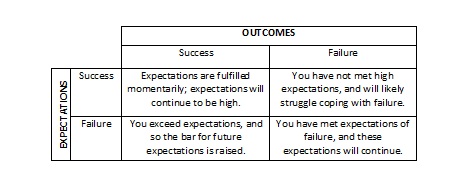
As you can tell I’m not a huge fan of expectations. Now, an opposing view to my opinion might go something like, “But Gaurav, what about when you are expected to fail, but then you go ahead and succeed, isn’t that a positive thing?” Yes, that is a positive thing, but it happened in spite of the expectation, rather than because of it. Expectations are often thought of as a type of motivation, but I’m of the opinion that that motivation comes from the final stage of success or failure, and motivation’s correlation with expectations is purely coincidental. I will get into more about why I’ve come to this conclusion, but I’m getting ahead of myself.
The point is that in order to best prepare for failure, you must temper expectations. Notice that I used the word “temper” instead of “eliminate”. It is human nature to hold expectations, so unfortunately it is something we all have to deal with. When you are working towards a goal, try to imagine both scenarios and your reaction to either attaining your goal or falling short. So, preparing for failure means knowing that it is possible, thinking about that scenario, and imagining how you will react.
Coping With Failure
No matter how much you prepare for failure, once it hits, it is never easy to take. Coping is an important stage of failure because oftentimes emotions ride high after you set a goal and you are unable to accomplish it. If you don’t take some time to understand and work through these emotions, they can often complicate understanding or learning from your failure, or even worse linger and settle as negativity.
The first thing is to accept the onslaught of emotions. When I got the news that I didn’t get into Neuroscience, I was devastated. My emotions went from a plunging feeling of despair deep down inside of me, to being angry at the selections committee, and then shortly afterwards being angry with myself. If you repress these emotions and try to instead immediately focus on the positives of a failure, you might feel better in the short term, but eventually those feelings will resurface. It’s kinda like when Homer Simpson had those wart things popping out of his neck that he pushed back in every time he was angry, only to eventually lose it. Learn from the Simpsons, and don’t let this happen to you.
As important as allowing yourself to feel negative after a failure is, you must move past this stage. Sometimes this just happens naturally, but it can also be difficult to do when you suffer a major setback. Personally, I find talking it out with someone else is the best way to get over feeling negative. Other people often provide good insight or opinions, but mostly, just the fact that they are there to listen is the best part. In my future studies, I want to learn exactly why getting things off your chest and sharing your thoughts with other people makes you feel so much better, because it is interesting how effectively it works.
Another thing to consider is whether your failure is actually something to be upset about. It’s interesting to note that feelings associated with different types of failure are very culturally dependent. In our individualist culture, we value standing out from the crowd and being individually successful. However, in some collectivist cultures, if you failed at being personally successful, this would be viewed as an opportunity to avoid the shame of standing out from the crowd and leaving behind your friends and family. Sometimes seeing things from another perspective, and noticing just how arbitrary the feelings you associate with failure are, can help you feel better as well.
Analyzing Failure
After you have coped with your failure, you are in the state of mind to analyze it. Why should we analyze our failures? It’s pretty self explanatory: you have to understand what went wrong if you want to prevent it in the future. If you begin this stage too early while you are still highly emotional, pointing fingers and making excuses can become a part of your analysis, rendering your failure difficult to learn from.
So how exactly can you analyze your failure? Well firstly, it is important to gauge how much responsibility you hold in your failure. For example, in failing a class you should take a lot more responsibility for your result than if you failed to win a multimillion dollar lottery. To make this judgement, you need to understand what factors played into your failure, and group them as within your control and out of your control.
Let’s take Joe for example, an imaginary figure who fails his physics class. After failing the course, Joe determines a list of core factors that contributed to his failure.
Factors
1. Getting sick a day before the final exam
2. Not turning in a couple of homework assignments
3. His teacher was a harder marker than other physics teachers
4. Never asking questions in class or going for extra help even though he didn’t understand
5. It was his birthday the weekend before his midterm
Joe came up with these factors by comparing the things he did differently in this class with the other classes he was in during the same time, as well as the physics courses he had completed in the past. He decides that factor 1 was out of his control, because he didn’t do anything before his exam that would make him more vulnerable to getting sick than normal. He also decides that factor 3 was out of his control, because he didn’t choose his instructor. Finally he decides that factor 5 was out of his control because he doesn’t control when the midterms are placed and it was just bad luck. The other two, he admits, were his fault.
Now, many of you might see that factor 5 is not really out of his control. Although the midterm was right after his birthday, he could have started studying for his exam earlier since he knew his birthday was coming, or he could have put off the celebration for a week until his midterm was over. All of this to say that you should often check your groupings with someone else, just to make sure you aren’t too lenient or too harsh on yourself.
Anyways, now that Joe has grouped the factors, he has to decide what he could have done about the things that were in his control. There is no use worrying about factors beyond his control because usually they are exceptional and won’t recur on a regular basis. He can’t do anything about them! To find a better model for the things he needs to approve on, Joe should look towards other times he has succeeded at something similar, or how other people around him did well in his Physics course. Personally, if I usually do well at something and there is a time when I fail, I prefer focusing on my own experiences of past success because sometimes what works for others isn’t what works for me. Regardless of the situation, keeping an open mind when talking to others will only benefit you in the end, giving you more avenues to learn from your mistakes.
Moving On
After feeling negative, analyzing your mistakes and then learning from them, you must prepare to move on. Setting goals after a failure is one of the most important things you can do. In my case, my goal is to re-apply for Neuroscience in the coming year with better marks and a stronger essay, and take a second crack at getting in. In Joe’s case, his goal might be to retake the physics course and ace it, or to choose a different course and make up for the fail with an excellent mark. Only by setting new and attainable goals will you have the motivation to succeed, and the opportunity to use the knowledge you have acquired from your previous failure. Now although this post is about dealing with failure, this paragraph is also perfectly applicable to success. After you bask in your success a little bit and go over the things that made you successful, you’ve got to set a new goal to put what you’ve learned to use.
Finally I wanted to revisit the idea that expectations do NOT provide motivation. Expectations are passive and encourage being passive, but motivation is active and so is goal setting. For example, if an Olympic high jumper sets a goal to clear a 3m bar, they will train harder and harder to achieve that goal. However, if the jumper develops an expectation that they can clear a 3m bar easily, or even the expectation that they will never be able to make a 3m jump, they might train less vigorously or might stop training altogether because they already have an expectation. I hope this example explains how goal setting encourages motivation, and expectations can discourage motivation.
I hope this post is of value to some of my readers – it certainly helped me organize my thoughts on success and failure. Although I don’t expect anyone to take notes on this and then make a list of factors to analyze their failures every time, I broke it down with the hope that going through this process might provide a logical framework for most situations. I personally have never written out a list of factors (although it is a good idea now that I think about it), but I definitely go over that stuff in my head when I’m reflecting on my experiences. Anyways, here’s to hoping you set goals and work hard enough that you don’t have to think about this post when it comes to the things that matter most to you.
Best of luck!
Yesterday started with my first French lesson. It was just me and the teacher for 2 straight hours, which was the upside. The flipside was that the teacher is not fluent in English, so he couldn’t provide much help translating words I didn’t understand. However, he’s a great guy. It went well.
After the lessons it was laundry time! My first time hand washing clothes (hockey equipment doesn’t count) in at least 10 years... and it showed. My host mama soon took over and I was relegated to rinsing and hanging the clothes on the line.
The day really took off however, when Jules and Jennifer dropped by.
When you hit rock bottom, the only way to go is up. But I can’t help but think I’ve gotten a hold of a blimp or something, because now I’m soaring.
What did it take to break me out of my funk? It seems it was just a contemplative ride back from Cotonou, and 850 francs (about $1.85).
On my way back from Cotonou on Wednesday, after a day of visiting embassies, Benin’s sole superstore, and a street-side restaurant with authentic Cote D’Ivoire cuisine, I sat silently in the back seat, watching as our common taxi drove past streets busy with motos, street vendors, and always, someone yelling. It's called a common taxi because the driver doesn't leave the station until they have packed 2 people in the passenger seat and 4 in the back. Jules paid for the 4th spot at the back so we could have some space. Him and Jennifer, the other volunteer who arrived Tuesday night, were fast asleep.
I was at peace. It had been a good day. And then it hit me – I’m in Benin. When you experience culture shock, climate shock, and most other types of shock, the magnitude of this statement may evade you. It had evaded me, until that moment. I was experiencing something few people have a chance to live, and my visit here might be my only time in Benin, ever. Then slowly, it all began to soak in, truly, for the first time. The sights, the sounds, the colours. The people. And I began to warm up to my stay here.
On the way home I decided to pick up a small bamboo carpet for my room, because I had grown tired of the unwelcoming concrete. When I got home, my spirit carried over with me: I obtained a broom and swept my room. Then I laid out the carpet and rearranged the desk and chair. Finally, I removed my suitcase from my bed (under the sanctuary of the bug net), and unpacked my clothes, officially moving in.
It felt so good to make the room more homely. It was just a few minor changes, but it was a major paradigm shift. It made me look forward to coming home, a difference from the past week. I made do with what I had and honestly embraced it for le premiere fois. The extreme makeover was complete.
I promised pictures with this post, and here they are. I forgot to take a picture of my room after the "renovation" but truthfully, the bamboo rug doesn't really change much visually, so I've included photos from my room that I took last week.
Just click on the photos to see them at their true resolution!
 |
| My room from the courtyard |
 |
| The bed with blue bug net above :) |
 |
| The shower |
 |
| The Toilet |
 |
| The picture shows the interior of the common taxi's hatchback, and how the road from Cotonou to Ouidah is littered with "motos", known in North America as scooters. |
So, Monday was my first day of work at the orphanage. It was one of the most difficult days of my life.
I began the day waking up early in the morning, getting showered and ready by 7 am. Jules told me that we would be going to the Cotonou to visit the Consulate and pick up my phone in the morning, and I would visit the orphanage in the evening to set a schedule for the work I was going to do with them. However, when he arrived he said the plans had changed and I would stop by the orphanage in the morning instead. He was busy and had to go to Cotonou during the night anyways to pick up another volunteer, so we could get my phone then. (I don’t know if this has been made explicit yet, but Cotonou is the main city in Benin, and it’s about 40 km from the small town Ouidah where I am staying, so you have to go there to do pretty much everything).
So we headed off to the orphanage. When we got there, the director was not in sight. He had to take one of the young children to the hospital and was gone all day. However, his assistant Raphael (another volunteer, although he is a native of Benin), was there. Raphael lives with the children at the orphanage and hopes to be a pastor in a Methodist church one day.
Jules left me with Raphael and said he had to go prepare things at the volunteer house for the other volunteer who was arriving tonight. He said I should go over my duties at the orphanage with Raphael, and head home for lunch, and return to the orphanage later in the day.
Raphael spoke no English, so it took my toddler French about an hour to learn what the daily activities were. Without further instruction on what to do during the day, we proceeded to go through them.
This was a big mistake for me. Why? One word: heat. The heat in Benin is not like the heat in Canada. In Canada I have survived temperatures as hot as 38 degrees centigrade. It was only 29-30 degrees on Monday. However, since Benin is so close to the equator, and Ouidah is so close to the coast, it fits right in as a humid tropical climate. Equally as unfortunate, one of my many Achilles heels just so happens to be humidity, and I can even go so far as to say it is my greatest physical weakness (please, any arch enemies who are reading this, don’t use this against me). Here’s an example of how even the slightest humidity can literally destroy my will to live: when I take a shower here, during the time it takes me to dry myself off, walk a distance of one foot to my bed, and get under the bug net, I am sweating so much that it feels like I’m still in the shower. I know, it’s disgusting (please, arch enemies, respect the same message). However, it’s just how I am, and I can’t change it.
And it’s just how Benin is and that won’t change either. Walking home for lunch, my clothes stuck to my body with sweat and eyes watering from all the dust and salty sweat obscuring them, I had one thought: I want to get out of this place as soon as possible. In my mind, I was already deciding whether it would be worth the wait to change my flight the slower but cheaper way by email, or if I should pay up and do it by phone. Another factor that played into my mood besides the ever brutal air thick with moisture, was how unrewarding my day at the orphanage had been.
We had spent the day mostly lounging around, and when the kids needed to be dropped off or picked up from school, I superfluously accompanied Raphael on the dreadful walk. We tilled the ground at the vegetable patch with some spades, and although Raphael was encouraging, I know I sucked at it. Otherwise I watched as he collected eggs from the chicken coup in the orphanage. I felt useless and only showed signs of life in the shade. It was terrible.
The plot was bad, but the setting was downright depressing. I have pictures of the orphanage that I have taken since (I didn’t have my camera with me that day), and they will do better justice to the truth of these children’s lives than my words can. However, let me share one story that might put this in perspective.
We returned to the orphanage after our work at the garden and I was beginning to feel dizzy from the water loss from perspiring. I asked Raphael there was some chilled water I could drink to replenish myself; he said that there was water, but it was not chilled. The orphanage did not own a fridge. Thirsty as hell, I told him that was fine and we proceeded to the kitchen. On the countertop sat a pot with what looked like charred fish. There must have been two dozen flies sitting on the fish or buzzing around it. Raphael saw this and called for one of the children, who promptly brought a filthy rag and threw it over the pot nonchalantly. I was alarmed, but Raphael did not respond, so I understood this to be normal. Then Raphael retrieved a smaller pot, which he dipped into an old yellow container full of water for washing hands, which probably held gasoline in the past. As I saw his hand touch the water, I cringed a little. He had just contaminated the whole pot – earlier he had used the washroom without washing his hands. Choosing to ignore this, I held out my hands below the pot, and this is the real reality check – Raphael shook his head, raised the pot to his lips, and drank from it – motioning for me to do the same. I hesitated for a moment, and in that moment you can imagine the sanitary concerns that ran through my head. But it was a brief moment, and I took the pot from him and gulped down half of it before handing it back.
Around 5pm, after making my third round trip to the school, I decided it was time for me to head home. This time I wisely took a moto taxi (pictures coming next post, I promise), grudgingly accepting that I probably shouldn’t subject myself to probable harm as an excuse to head home. Although the ride was refreshing, I had made up my mind: I could not handle working at the orphanage anymore, the heat was too much.
Later that night, Jules dropped by my host family’s house to pick me up for our late night journey to Cotonou. Since he was early, we stopped at a bar for drinks before we left Ouidah. I decided that I would discuss my concerns about the day with him and tell him how I felt about sticking around.
At the bar I was more at ease because the night had settled in and a gentle breeze had started flowing through the streets. Sipping on my drink, a carbonated blend of delicious fruit juices, I explained the difficulty of my experience and my concerns about the future with great detail. When I was done, Jules laughed. “It only took one day, huh?”
I glared back. I had a feeling he wouldn’t understand, because he was accustomed to the heat. However, Jules continued. “Look,” he said. “I know it was difficult to live like that, but that is someone’s life. Raphael and the children live that every day”. He continued, explaining how important it was to live poverty rather than just see it, in order to understand it fully.
“You’re right in saying that you shouldn’t be doing manual labour, that’s not your expertise. We will look for a different way for you to help the orphanage, maybe you can start on the administrative side of things right away. You won’t spend another day like that, I’ll make sure of it. But let me ask you one question... now that it is over, now that you are sitting here with me and we are enjoying Ouidah. Was it a bad experience?”
I thought about it for a moment and a grin slowly started to spread across my face. “Jules,” I said emphatically, “No experience is bad experience”. Jules grinned back and we were soon laughing together.
The sun had set on the day that shook my personal will, right down to its foundations. And I was still standing, albeit slumping. It had passed - and in doing so, it had felt like my judgment day.
EDIT:
The pictures below were taken during my second day, when I returned to discuss my position in helping out the orphanage. It was suggested that taking photos to raise awareness would be a good start.
EDIT:
The pictures below were taken during my second day, when I returned to discuss my position in helping out the orphanage. It was suggested that taking photos to raise awareness would be a good start.
 |
| Raphael turning for a picture while gathering water from the well |
 |
| This child is in the midst of exam period, and is using his time off to help with some cooking. |
 |
| This is the kitchen that I mentioned in my post. |
 |
| The boys washroom. Raphael explained that they squat close to the green pail and use the water in the containers to "flush" the toilet through the hole. |
 |
| The youngest of the 45 is not old enough for school yet, so I was able to snap a couple photos of him during my visit. |
 |
| Inside the chicken coupe with Raphael. This is in the middle of the orphanage. They sell the eggs and meat to fund their activities, but they don't make nearly enough in a city where 30 eggs can be bought for $1.50. |


