I gripped the chalk, a grain about half the size of the nail on my pinkie finger, and about as thick – tightly between my thumb and forefinger. My hand trembled slightly as I raised my hand up to the smooth wooden chalkboard. It leaned against the wall behind me and rested perilously upon a wooden bench opposing another one of the same, upon which sat my first ever class of students. Eight pairs of eyes stared up at me eagerly: some familiar, some not, and all clearly waiting upon my next words of instruction. Each of them had already flipped to a fresh page in their books, pen or pencil at the ready. I turned to face the board, and began to write, a shadow of chalk powder trailing my fingers as I sketched out the letter “E”. And so it began.
Showing posts with label academic success. Show all posts
Showing posts with label academic success. Show all posts
The class, as of now comprises of 8 kids. Some of them are from the orphanage, and others are from the community around the orphanage. I hope I can find a couple more children over the weekend in bring the number to about 15. We meet at the orphanage from 10am to 12pm, Tuesdays and Thursdays. They vary in age from 10-16 and all have some background in English, but nothing more than “good morning” or “fine, thanks”.
I am not a qualified teacher. I don’t have experience teaching groups. I’ve never even tutored English. Before my first lesson on Thursday, I hadn’t created a lesson plan, anticipated the interest level of the students, formed a method to gauge the previous understanding of English my students held, or realized how hard it would be to keep everyone engaged when I had such varied levels of comprehension to work with. So you can see why I was nervous right before the lesson.
Although we started kind of shakily, just like my confidence, the lesson began to settle as I got into a steady rhythm. Before long, it was flowing naturally. The most rewarding thing as a teacher is when you spend 10 minutes explaining something and then a child is able to apply what you said to answer a question about it. Not only does it keep the kids engaged, but it is such necessary feedback for me to receive when I’m up there, just so I know if I need to do a better job of explaining or if I can move on.
On the other hand, it can be equally frustrating when you feel like you’ve spent your time teaching something and not a single hand goes up when you ask a question. Or when you have to stop mid sentence because it is clear that no one is listening. Nevertheless, after my first lesson was complete, I was feeling pretty good about myself and what we had gotten through – then one of the students reminded me that they need homework.
After assigning the homework, I could already see myself thinking ahead to the next lesson, anticipating how it was going to play out. I was kinda excited! Starting these lessons was a great idea – it provides some structure to my day, and gives me a set schedule. And to be honest, its more motivating than grant work because with this you can see the results much more immediately.
I have a lot of respect for teachers. I always have, even before Thursday, but a little more empathetically now. It is not easy to stand in front of a class full of people and keep them entertained while juggling parenting, teaching, staying patient, being a role model, and always trying to spark some passion all at the same time. However, teachers have to deal with more than just these things. Back home, I have shied away from thinking about a career in teaching just because of all the inner politics that exist within the education system’s hierarchy. It is disheartening how the school can be a truly bureaucratic institution, and that is not something I think I can deal with. What I’ve seen as a student is probably only the tip of the iceberg. I’m glad that I can stay away from that in my small English lessons at the orphanage, but there are those who don’t, and brave the sometimes hostile environment to teach kids who might never realize or appreciate the impact that their teachers often have in shaping who they are.
So I guess the title of this post ended up being one of those classic “phrases with intended double meaning” (is that really classic? I kinda just made that part up). I suppose it’s only fitting that I probably learned more than my students during my first lesson, because part of being a teacher is having a constant willingness to learn as well as teach. Teachers deserve a lot more respect than they ever actually get, and in my eyes it’s as prestigious of a profession as the doctors and lawyers of this world can lay claim to. The role of a teacher is so important that becoming one should be just as selective of a process as choosing doctors or lawyers. My thoughts on how little training teachers require in comparison to those two other professions is a rant made for a different post. Here, let me just take the opportunity to thank the teachers that have been such an important part of my life.
One love to my teachers, if any of you are reading this. And if you just so happened to teach me English in primary school, would you mind if I took a look at your lesson plans quickly? Peace.

Preparing for Failure
I know it sounds silly at first, but preparing for failure is one of the most important things you can do. The fact that everyone fails at something or another at some point in their life is unavoidable. In preparing for failure, you can often cushion the blow when you don’t reach your goal, allowing you to bounce back quicker and set goals all over again.
Preparing for failure involves thinking long and hard about expectations. When I say that it is inevitable that everyone fails at something, I’m not advocating that you expect to fail. Just the same, you should never expect to succeed. I’ve come to a conclusion about expectations through reflection and experience. To make this a little easier to show than a big fat paragraph, I’ve summarized my thoughts into this table below:
Preparing for failure involves thinking long and hard about expectations. When I say that it is inevitable that everyone fails at something, I’m not advocating that you expect to fail. Just the same, you should never expect to succeed. I’ve come to a conclusion about expectations through reflection and experience. To make this a little easier to show than a big fat paragraph, I’ve summarized my thoughts into this table below:
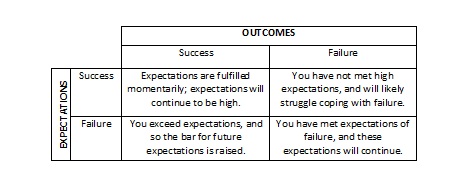
As you can tell I’m not a huge fan of expectations. Now, an opposing view to my opinion might go something like, “But Gaurav, what about when you are expected to fail, but then you go ahead and succeed, isn’t that a positive thing?” Yes, that is a positive thing, but it happened in spite of the expectation, rather than because of it. Expectations are often thought of as a type of motivation, but I’m of the opinion that that motivation comes from the final stage of success or failure, and motivation’s correlation with expectations is purely coincidental. I will get into more about why I’ve come to this conclusion, but I’m getting ahead of myself.
The point is that in order to best prepare for failure, you must temper expectations. Notice that I used the word “temper” instead of “eliminate”. It is human nature to hold expectations, so unfortunately it is something we all have to deal with. When you are working towards a goal, try to imagine both scenarios and your reaction to either attaining your goal or falling short. So, preparing for failure means knowing that it is possible, thinking about that scenario, and imagining how you will react.
Coping With Failure
No matter how much you prepare for failure, once it hits, it is never easy to take. Coping is an important stage of failure because oftentimes emotions ride high after you set a goal and you are unable to accomplish it. If you don’t take some time to understand and work through these emotions, they can often complicate understanding or learning from your failure, or even worse linger and settle as negativity.
The first thing is to accept the onslaught of emotions. When I got the news that I didn’t get into Neuroscience, I was devastated. My emotions went from a plunging feeling of despair deep down inside of me, to being angry at the selections committee, and then shortly afterwards being angry with myself. If you repress these emotions and try to instead immediately focus on the positives of a failure, you might feel better in the short term, but eventually those feelings will resurface. It’s kinda like when Homer Simpson had those wart things popping out of his neck that he pushed back in every time he was angry, only to eventually lose it. Learn from the Simpsons, and don’t let this happen to you.
As important as allowing yourself to feel negative after a failure is, you must move past this stage. Sometimes this just happens naturally, but it can also be difficult to do when you suffer a major setback. Personally, I find talking it out with someone else is the best way to get over feeling negative. Other people often provide good insight or opinions, but mostly, just the fact that they are there to listen is the best part. In my future studies, I want to learn exactly why getting things off your chest and sharing your thoughts with other people makes you feel so much better, because it is interesting how effectively it works.
Another thing to consider is whether your failure is actually something to be upset about. It’s interesting to note that feelings associated with different types of failure are very culturally dependent. In our individualist culture, we value standing out from the crowd and being individually successful. However, in some collectivist cultures, if you failed at being personally successful, this would be viewed as an opportunity to avoid the shame of standing out from the crowd and leaving behind your friends and family. Sometimes seeing things from another perspective, and noticing just how arbitrary the feelings you associate with failure are, can help you feel better as well.
Analyzing Failure
After you have coped with your failure, you are in the state of mind to analyze it. Why should we analyze our failures? It’s pretty self explanatory: you have to understand what went wrong if you want to prevent it in the future. If you begin this stage too early while you are still highly emotional, pointing fingers and making excuses can become a part of your analysis, rendering your failure difficult to learn from.
So how exactly can you analyze your failure? Well firstly, it is important to gauge how much responsibility you hold in your failure. For example, in failing a class you should take a lot more responsibility for your result than if you failed to win a multimillion dollar lottery. To make this judgement, you need to understand what factors played into your failure, and group them as within your control and out of your control.
Let’s take Joe for example, an imaginary figure who fails his physics class. After failing the course, Joe determines a list of core factors that contributed to his failure.
Factors
1. Getting sick a day before the final exam
2. Not turning in a couple of homework assignments
3. His teacher was a harder marker than other physics teachers
4. Never asking questions in class or going for extra help even though he didn’t understand
5. It was his birthday the weekend before his midterm
Joe came up with these factors by comparing the things he did differently in this class with the other classes he was in during the same time, as well as the physics courses he had completed in the past. He decides that factor 1 was out of his control, because he didn’t do anything before his exam that would make him more vulnerable to getting sick than normal. He also decides that factor 3 was out of his control, because he didn’t choose his instructor. Finally he decides that factor 5 was out of his control because he doesn’t control when the midterms are placed and it was just bad luck. The other two, he admits, were his fault.
Now, many of you might see that factor 5 is not really out of his control. Although the midterm was right after his birthday, he could have started studying for his exam earlier since he knew his birthday was coming, or he could have put off the celebration for a week until his midterm was over. All of this to say that you should often check your groupings with someone else, just to make sure you aren’t too lenient or too harsh on yourself.
Anyways, now that Joe has grouped the factors, he has to decide what he could have done about the things that were in his control. There is no use worrying about factors beyond his control because usually they are exceptional and won’t recur on a regular basis. He can’t do anything about them! To find a better model for the things he needs to approve on, Joe should look towards other times he has succeeded at something similar, or how other people around him did well in his Physics course. Personally, if I usually do well at something and there is a time when I fail, I prefer focusing on my own experiences of past success because sometimes what works for others isn’t what works for me. Regardless of the situation, keeping an open mind when talking to others will only benefit you in the end, giving you more avenues to learn from your mistakes.
Moving On
After feeling negative, analyzing your mistakes and then learning from them, you must prepare to move on. Setting goals after a failure is one of the most important things you can do. In my case, my goal is to re-apply for Neuroscience in the coming year with better marks and a stronger essay, and take a second crack at getting in. In Joe’s case, his goal might be to retake the physics course and ace it, or to choose a different course and make up for the fail with an excellent mark. Only by setting new and attainable goals will you have the motivation to succeed, and the opportunity to use the knowledge you have acquired from your previous failure. Now although this post is about dealing with failure, this paragraph is also perfectly applicable to success. After you bask in your success a little bit and go over the things that made you successful, you’ve got to set a new goal to put what you’ve learned to use.
Finally I wanted to revisit the idea that expectations do NOT provide motivation. Expectations are passive and encourage being passive, but motivation is active and so is goal setting. For example, if an Olympic high jumper sets a goal to clear a 3m bar, they will train harder and harder to achieve that goal. However, if the jumper develops an expectation that they can clear a 3m bar easily, or even the expectation that they will never be able to make a 3m jump, they might train less vigorously or might stop training altogether because they already have an expectation. I hope this example explains how goal setting encourages motivation, and expectations can discourage motivation.
I hope this post is of value to some of my readers – it certainly helped me organize my thoughts on success and failure. Although I don’t expect anyone to take notes on this and then make a list of factors to analyze their failures every time, I broke it down with the hope that going through this process might provide a logical framework for most situations. I personally have never written out a list of factors (although it is a good idea now that I think about it), but I definitely go over that stuff in my head when I’m reflecting on my experiences. Anyways, here’s to hoping you set goals and work hard enough that you don’t have to think about this post when it comes to the things that matter most to you.
Best of luck!
So, we have come to the long awaited multiple choice strategies post. A large number of your tests during your first year of university or college will probably be multiple choice, especially if you are in a science program. I love multiple choice tests because they are not subjective, the answer is given to you, and managing time is simple since all questions are of equal weight.
Before you read my post, you should probably know about my inspiration for writing it. There is a post over at MedHopeful by Joshua that I read during my last year of high school on the same subject. I found it very helpful and I recommend that you read it first before you continue to read mine. Since it is so well written, I will not be repeating the strategies discussed there. My post here might be considered my personal addendum to Joshua’s post.
Let me start this off with a full disclaimer: the tips I share here are by no means foolproof, (So yes, the title was a ploy to catch the attention of more readers). Learn from them, but if you follow them for every single test you write, you may not be very successful. I will discuss why this is so in depth during the next section of this post. The majority of these strategies deal with narrowing down options on questions you have no idea how to answer. The truth is that even very well prepared students sometimes face a question they don’t know the answer to – but that doesn’t mean they have to get it wrong.
Now! Lets get started.
Not all Multiple Choice Tests are Made Equal
You might write multiple choice tests in many classes and feel like they are all the same basic concept. Well, you wouldn’t be wrong! Multiple choice tests all have the same attributes: many questions to answer that are usually allotted 1-3 minutes each, 4-5 possible answers, and equal weight all for correct answers. Some multiple choice tests deduct marks for wrong answers – most don’t. Joshua discusses multiple choice tests that deduct marks very thoroughly, so I will leave it up to you to read his post if you are interested in that subject.
So how are multiple choice tests different? From what I’ve seen, the way multiple choice tests are designed can vary substantially from class to class BUT remain very consistent from test to test within the same course. This is because different professors design their questions differently. Why? Sometimes, multiple choice tests are designed differently because of the course content. For example, you will consistently see “all of the above” or “both a and b are correct” in knowledge-heavy courses like biology, but you will be hard pressed to find options like that on a calculus exam just because of the nature of mathematics. Even MC tests for the same subject can be written differently – it’s often a matter of the professor’s personal preference. A very particular professor may often throw in trick questions to see if you are paying close attention to details, whereas a professor with a different teaching style might not agree with the concept of trick questions.
It’s important to understand the design of the test, because it helps you select your strategies appropriately, study efficiently and save time on the test. For example, one of your MC strategies for biology might be to go through each of the answer choices and see if they are true or not after you read the question. On a calculus exam, just calculating the answer and looking for it among the options would be much more efficient than working backwards through each of the options. For the same math exam, you would spend more time doing calculations in preparation for the exam because you know that’s what you will be tested on. Finally, when you know whether applying certain strategies on a test will work or not, you can immediately decide how to approach a question once you read it. It will save precious time on the test.
So how do you know how your test will be styled? Well, the first thing to do is a take a look at the course syllabus. Look for key words like “knowledge and understanding of” (like completing readings) and “application of concepts” (like doing calculations) to decide what the purpose of the course is, and as a result, what you can expect on the tests. Since it usually depends on the professor as well, pay close attention to your professor in lectures. My psychology professor told us at the beginning of the semester that he would not put any trick questions on the exam, and he held true to his word. However, the best way to understand the tendencies of your professor, (whether they: enjoy putting many “all of the above” type options, require calculations, focus on details or larger concepts, have a tendency to include outlier options, include simple diagrams or expect you to draw your own, etc.) is through the actual tests themselves. Sometimes past tests are made available: check your library, google search, or sometimes they are given by profs as practice material. It is essential that you go over these and recognize the tendencies of your professor so you can prepare yourself appropriately. If you have no sample questions available, it can be useful to make mental notes about the types of questions you are encountering most as you move through a test. If you often leave tests early, after checking your answers, take some time to analyze the format of the test before you hand it in.
So now that we’ve covered how to distinguish between test types, let’s get down to the strategies themselves.
How to Approach Questions with Multiple Similar Options
When faced with a question with a question that has two or three similar options and the rest are different, often times the correct answer will be one of the similar ones. This is because professors know that some students will know part of the answer but don’t know the second part or don’t have enough knowledge of detail. They like to weed out these students by presenting two similar options, forcing the student to guess. However, this format can also benefit some students: the ones who don’t know anything about the question to begin with. For examples, I am going to use questions from a practice exam provided by my chemistry professor during first semester. Take the question below for example:

Let’s say you have no idea how to approach this question. If you take a look at the possible answer choices, you will notice that there are two options that are more similar than the others, just based on how they are written. They have the exact same words and spelling in them, but are just in a different order. They are A and C. Now, you only have to guess between 2 possible answers rather than 5. In this case, the correct answer is C.
Sometimes on calculation based tests, the opposite is true. Say for example you are faced with a question like, “What is a good decimal approximation of 2/3?” In this example, let's say there are the following four possibilities:
A) 0.23
B) 0.2
C) 0.67
D) 0.22
Unless the professor is testing you specifically on something like significant digits, it is unrealistic of them to expect you to distinguish between the very similar options A, B and D. As a result, the correct answer can only be C. Warning: this situation is not exactly common, but I’ve seen it at least a couple times so I thought it was worth mentioning. This is a good example to relate back to the first part of this post: remembering what the prof is looking for is IMPERATIVE. If they were testing significant digits, and the question said 1/3, this would be a perfectly valid question with 3 viable options.
It’s Never Answer E
Ok, just kidding. If only multiple choice tests were that easy! However, there is an important strategy concerning the situation where your final option on a MC question is “all of the above” or “none of the above”. When you don’t know how to approach a question like this, it is important to consider that the last option has more requirements to be correct than all of the other options. If “all of the above” is the correct option, all of the 4 statements above MUST hold true. This is less likely than only 1 of the statements holding true. Let’s break this down to probability: each statement has an equal probability of being true (50% of the time) and being false (50% of the time). It is helpful to compare this to a coin toss, so let’s assign heads to a true statement and tails to a false statement. If you flip 4 coins, the probability of you getting a mixture of heads and tails is more likely than you getting 4 heads (or no heads, if the question says none of the above). You can see this on multiple choice tests: if you go through answer keys for multiple choice exams, and only look at the questions with an “all of the above” type answer, that option shows up as the right answer less often than 25% of the time for tests with 4 options per question.
All of this is to say that if you have absolutely no idea how to approach a question like this, pick the “all of the above” option less often when you are guessing. However, DO NOT use this strategy when you see at least two statements that you know are correct. Another example where this advice goes down the drain is when your professor only has 2 or 3 questions with an “all of the above” option. In this case, the professor probably included this option because it has significance as either the correct answer, or being a trap answer (common misconception). This strategy is a desperate last measure if you can’t narrow down the options at all.
Personally, I appreciate questions with an option type like “none of the above”, because if you find fault in even a single one of the other options, then you can cross out 2 possible answers instead of one, largely increasing your odds of getting a question right. It’s like a freebie!
Spot the Outlier
Some teachers choose to make this pretty damn easy. Since exams are stressful, many times teachers throw in a question with a ridiculous option choice. I’ve had some pretty wacky things come up on exams, anything from “spongebob squarepants” to “@&^!*#!!”. Although not all outliers are always this visible, the point is that they are often present in questions and can help you narrow down option choices.

In this question, A is visually the outlier, you can spot it at a glance because it looks different than the other options. Sometimes spotting the outlier requires a bit of knowledge about the subject or reading through the options and it does not “pop” out as an outlier.

Above, the outlier (D) is not as easy to spot since it does not visually pop out. However, all of the other options include the word “theory”, and the outlier does not. Since the question asks what the “concept” belongs to, it makes more sense that a concept would belong to a theory, rather than a concept belonging to a concept. Spotting this outlier requires a bit of knowledge about the terms “concept” and “theory”, as well as some logical reasoning.
Look for Hints in Other Questions
I used to treat multiple choice tests on question by question basis. However, I realized that it is more beneficial to consider the multiple choice test as a whole. When you do this, it is easy to see that multiple choice tests contain a whole slew of free information – they are practically cheat sheets. How is this possible? Since many of the concepts you are being tested on are related, referring back to questions you have already answered can sometimes help you narrow down options or understand concepts for a different question you are having difficulty with.
Let’s delve a little into this by scrolling back up to the first example I provided from my chemistry exam. We can identify this question as a naming type question. After narrowing down the options based solely on which are most similar to each other, we deduced that the correct answer was C. Now say if later on in the test, you are presented with another naming type question, but this time all of the options are drastically different. Well, you could just guess, or you can refer back to our example and use it as a blueprint for working on the question you are having difficulty with! Every time you get an answer right on the multiple choice exam, you are building your cheat sheet for the very same exam. I’ll make up a couple of questions so that we can investigate another common occurrence. Just because I’m not very creative, they are biology themed, but remember that this can be applied to any multiple choice exam:
Which of the following cell structures produces proteins?
A) Lipid Bilayer
B) Chloroplast
C) Ribosome
D) Electron Transport Chain
E) None of the Above
Let’s say you aren’t sure about A, B, or D, but you clearly remember your teacher talking about Ribosomes in the role of protein synthesis, so you (correctly) select C. Later on in the exam, you are presented with the question:
What type of proteins does the smooth endoplasmic reticulum create?
What type of proteins does the smooth endoplasmic reticulum create?
A) Intermembrane
B) Actin
C) Intramembrane
D) All of the above
E) The smooth endoplasmic reticulum does not create proteins
And you are stumped! You comb through your memory and the only thing you know about the smooth endoplasmic reticulum is that it is made of a lipid bilayer. If you neglected the rest of your exam, you would be forced to guess the answer to this question. But wait! If you looked back at the first question you answered, you could see that you chose Ribosome to be the correct answer. Therefore, the other options in that question MUST have been wrong. Now you have another piece of information: no lipid bilayers produce proteins. Finally, you can answer the second question correctly, with the answer E.
This is one of my favourite strategies because it can be used in any multiple choice exam: business, math, science, social studies, regardless of how the teacher designs it. Always! Use your exam as a resource whenever possible. This is why is it so important to skip questions that you are not sure about. Instead of wasting your time combing your memory on how to solve it, move on! There may be a question later on in the exam that provides some vital information about the one you are having difficulty with, or sparks your memory.
Identifying Trick Options
Trick options are the real silent killers when it comes to MC tests. You can expect to fall for a trick option trap if you don’t think critically about what is being asked, or if you rush through a test. Whether you fall for these options or not often comes down to your selection of inductive/deductive logic, attention to detail, and reading comprehension. It is debatable whether or not these are areas that it is fair for your professor to test you on or not, but I will not get into that debate. The reality is that you have to deal with them. Here are some strategies for identifying trick options:
1. An excess of detail
Professors know how most students think when answering questions, because they were once students themselves. Sometimes they will include a long and elaborate (albeit incorrect) option to trick students into thinking that since it has the most detail, it must be the correct answer. A common pitfall of many long statements is that the majority of the statement will hold correct, but a small detail will be incorrect, rendering the entire option wrong. To avoid falling for this trap, read through the WHOLE statement carefully when picking options with a long statement.
2. The false outlier
Once again, let me reiterate that tricky professors like to imitate how students think when they write tests. Sometimes they make all the answers similar except one, and the one that is different is the correct answer. Since students like to find shortcuts, they immediately cross out the different answer without properly understanding the question. This however, doesn’t happen that often because it is a freebie for students who read the question properly. The false outlier is MUCH more common on calculation type problems. This is because two drastically different numbers can be the result of a single calculational error, such as forgetting a negative sign. Professors make the outlier the correct answer, but then put an option that includes a small calculational error, and make the remaining options similar to the one with the small error. This way, a lazy student that doesn’t check their work gets the answer with the small error, sees that most of the rest of the answers are similar, and is content with their answer and doesn’t bother to recalculate. The lesson here is that you must always check your answers if you have time!
3. The negative, or double negative
This one is when professors play around with words to see if you are really paying attention to the test. Sometimes professors like to throw in a couple questions where a single word can change the meaning of the question. Joshua discusses this in his post. Read the question carefully! Remember, you can ALWAYS ask a supervisor to clarify what a question is asking.
4. The correct answer, but to a different question
Sometimes a question will have many options that all look familiar. Say if the question is asking for the definition of a certain term, they might include real definitions of other terms to confuse you. To combat this, DON’T just study key terms or notes at face value. Make sure you understand the material and make connections between why definitions make sense instead of memorizing. I have firsthand experience of this type of question screwing me over: During one of my chemistry midterms, I saw a diagram I had seen pop up on a practice midterm. Not knowing how to interpret the diagram because I had committed the answer on the practice midterm to memory, I got that one wrong because it was asking a totally different question.
5. Designed for common knowledge
One of the main themes of my first year uni education was disproving many common misconceptions the general public holds. Professors like to weed out people who are making guesses by putting in some options that are generally believed to be true by the public or have a different meaning when they are used in general terms. For example, sodium chloride is often interpreted as meaning the same thing as salt, whereas the technical definition of salt encompasses many more compounds. To avoid falling for these traps, read through all of the options and select the answer that is closest to what you were taught in class, rather than the answer that is closest to what the public (and sometimes even you) believe to be true.
In Closing
I hope the above tips and strategies will prove as helpful to all of you as they are for me. Remember: there is no substitution for studying and practice is the best way to become good at multiple choice questions. The only way I was able to analyze these trends was by doing many, many, MC tests throughout my life. I hope you got something from this post and I wish you the best of luck with your future tests!!
Please leave comments to let me know if this was helpful, if you have any questions, or if you feel I am wrong about anything. Thanks for reading!
Please leave comments to let me know if this was helpful, if you have any questions, or if you feel I am wrong about anything. Thanks for reading!


